

And Hilkiah the high priest said to Shaphan the secretary, “I have found the Book of the Law in the house of the LORD.” And Hilkiah gave the book to Shaphan, and he read it… Then Shaphan the secretary told the king, “Hilkiah the priest has given me a book.” And Shaphan read it before the king. When the king heard the words of the Book of the Law, he tore his clothes. And the king commanded Hilkiah the priest, and Ahikam the son of Shaphan, and Achbor the son of Micaiah, and Shaphan the secretary, and Asaiah the king’s servant, saying, “Go, inquire of the LORD for me, and for the people, and for all Judah, concerning the words of this book that has been found. For great is the wrath of the LORD that is kindled against us, because our fathers have not obeyed the words of this book, to do according to all that is written concerning us.” 2 Kings 22:8-13

WHY IS IT THAT SO MANY BELIEVERS CONTINUALLY WRESTLE WITH A GUILTY CONSCIENCE FOR FAILING TO READ THE BIBLE? We are not the first culture to suffer from declining biblical literacy, but we may be the most ironic given the ubiquity of the Bible today. The Bible was written in letters and books, not chapters and verses. Yet, most modern Bible reading plans and devotional books focus in on small sections and mashups of chapters and verses. Such approaches to reading may have their benefits, but many people struggle to stick with it. Let’s be honest, taken out of context, a few snippets of scripture can be confusing to modern readers. While it may not always be possible to consume an entire book in a single sitting, reading through large sections of scripture in a condensed period of time will help readers grasp the big picture story and themes that are key to receiving the message of the text as originally intended. Reading entire books in a single sitting is a worthy discipline to develop. But the reason so many struggle to get through entire books, much less the entire Bible, might surprise you.
The Bible as we have it today is designed for portability and easy navigation. Modern Bibles are commonly condensed into a single volume containing both Old and New Testaments. Usually these are organized in to 66 individual books in all, though some of these were originally combined. This is a massive amount of information to pack in to a single volume. In order to make the Bible more portable, we’ve compromised every aspect of the reading experience. In order to make the Bible easier to navigate to specific sections, we have divided the books in to chapters and verses. It is much easier to find specific sections of scripture this way. But at the same time, the Bible has become quite cumbersome to wade through. That’s because all of the added section headings, chapters, verses, footnotes, cross-references, and commentary have added an incredible amount of clutter which distract and impede reading. Such features may be useful in study, but they tend to get in the way of simply reading.

Are we there yet? If reading through the entire Bible were likened to taking a road trip across the United States of America, it would be like counting every single mile marker along the way–and every 10th of a mile! In so doing, we may miss the beautiful scenery all around us. The trip would become a drudgery rather than a pleasant and enjoyable adventure. And so it is with reading the modern Bible. As I pass multiple chapter breaks or see a chapter with more than 40 verses, I psychologically feel like I’ve been reading a long time, or at least that I’m getting tired of reading.
You aren’t a bad Christian. Instead of feeling guilty about our failure to read the Bible as we would like, we need to realize the Bibles we hold simply are not designed for such a purpose. They’re designed for portability, convenience, and quick navigation. It wouldn’t be practical to carry 66 books, much less a collection of ancient scrolls. It would be difficult for a group of people with different Bibles to find the same text without universal chapter and verse breaks. Our modern Bible serve the purposes they were designed for well. It just happens that immersive reading is not one of those purposes.

What if we designed Bibles that were laid out more like novels instead of textbooks or reference resources? In an era where Human Centered Design has become a professional occupation, we can take a fresh look at how we read scripture and realize there are numerous opportunities to design Bibles that are more intuitive and conducive to reading comfortably for greater lengths of time across large sections of scripture. What if we used thicker paper, larger font, bolder print, wider margins, more generous spacing, and single column layouts like any other book designed to be read and enjoyed for perhaps hours on end? What if we removed all of the clutter and got back to just the text itself? Fortunately, Bible designers and publishers have been doing exactly that in recent years.
Here are several physical and digital resources to enhance your Bible reading experience, but first, some pros and cons of digital versus physical.

I love books. Real books. And there are some good reasons for picking up an old fashioned physical Bible. One is the distraction factor. With a book in my hand, the only thing I can do with it is read it. If reading large sections of scripture is my goal, then the fewer distractions the better. With a tablet or smartphone, it’s just way too easy to flip over to another app or Web site, or be distracted by a notification. Before I know it, 20 minutes have gone by and I haven’t been reading. That’s not conducive to time alone with God, and it might even add stress during a time when I’m seeking peaceful solitude. Also, books don’t have backlights. Backlit digital displays can cause strain on the eyes and even cause difficulty with sleep at night. Books are easier on the eyes.
Digital devices have many advantages. You can easily choose any translation you desire. With certain apps, you can customize the colors, contrast, font style, font size, text layout, and even remove the traditional chapter and verse indicators. Of course, there are numerous ways to make digital devices less distracting and easier on the eyes with configurable settings to turn off notifications, reduce blue light, and even use restrictions to block unwanted apps and Web sites. Some tablets are designed primarily for the reading experience with anti-glare matte screens and gentle backlights.
Now let’s look at some specific Bibles I think are worth considering for extended daily reading.
My absolute favorite reading Bibles are actually divided in to multiple volumes to allow for the best possible reading experience. They do not cram all 66 books into a single volume.
 ESV 2016 6 Volume Set (out of print) by Crossway
This is a great, “essentially literal” translation presented in an elegant, easy-to-read-for-hours format. It has been published with and without chapters and verses. Minimal use of section headings make this Bible an incredibly smooth, distraction free reader. It was produced in paperback, cloth-over-board, and leather-over-board editions. But all editions are out of print, so you’ll need to find one of the few remaining copies as of the time of writing. This is my overall top pick. (see sample page image above)
 CSB 2017 5 Volume Set (out of print) by Holman
The CSB is rapidly becoming more widely used and recognized as both a reliable and easy-to-read translation. The translation philosophy is described by Holman as “Optimal equivalence” which just means it’s a balance between essentially literal and thought-for-thought paraphrases. The cloth-over-board edition is the only option. It doesn’t have verse indicators, but chapters are at the bottom of the page. Also, each chapter begins with a large, contrast color capital letter. This Bible is also out of print and never was updated to the latest 2020 edition of the CSB text. Christianbooks.com still has a few remaining copies as of the time of writing. I find the translation to be a smoother, easier read than the ESV, but the additional headings and more visible Chapter indicators are noticeable. This is my second favorite reader.

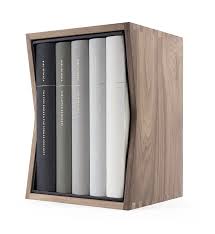 Bibliotheca
This is a bit of an exotic Bible in that it isn’t one of the common translations. It is a unique project that entailed producing and publishing a new highly literal translation based on the American Standard Version in a designed-for-purpose reader with elegant, natural materials that match the appropriate reverence for the word. The translation can be awkward in places, but the product is a splendid work of art. Bibliotheca was the instigator of the modern multi-volume readers Bible trend, even though Crossway beat them to market given their efficiency as a mass producer of Bibles. This is the most literal multi-volume readers Bible currently in print.
There are several other multi-volume sets that utilize less literal Bible translations, but they’re worth mentioning.
 NIV 2011 Sola Scriptura by Zondervan (out of print)
Christianbooks has a few remaining copies at the time of writing)
 NIV 2011 Books of the Bible and NIrV for Kids Books of the Bible by Zondervan
NOTE: The NIV 2011 is actually a revised and rebranded edition of the controversial TNIV. It is not the NIV 1984 some of us grew up with. One of the major shifts in the NIV 2011 was a move to gender-neutral language.
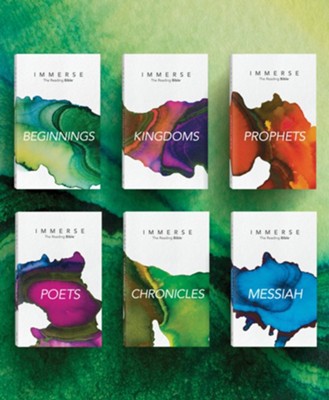 NLT Immerse by Tyndale
The NLT is more of a contemporary paraphrase than it is a translation, but is intended for natural, smooth reading aloud. Note that the “Messiah” (New Testament) book is the only one that can be found in Large print for an easier read.
 There are a few single-volume Bibles that are still decent readers. There are numerous single-volume reader’s Bibles which remove chapter and verse breaks and employ a single column layout with the text presented in paragraph form rather than verse-by-verse. However, they use smaller print with thinner pages. Additionally, the paragraphs are necessarily very wide and dense (not much white space). It becomes easy to lose your place in the middle of the page especially. I, personally, prefer a typical two-column large or giant print layout to these pseudo-readers Bibles. The Schuyler Quentel ESV (double-column) and Schuyler Treveris ESV are standout editions that are worth considering if a multi-volume set is not your thing, or you can’t find one in print. Schuyler also offers other popular translations such as the CSB, NASB, RSV, KJV, NIV, and NLT. For a lifetime of extended reading, the cost of a handcrafted Bible is worth the investment given they are easier to read and more durable. R L Allan also produces some of the finest Bibles in the world including an ESV New Classic Readers Reference Edition in double-column paragraph form. For a lot less money, There are the single-volume ESV Reader’s Bible and CSB Reader’s Bible as decent options.
Lastly, here are some great digital apps for reading scripture. All of them allow customizing the layout to remove distractions, changing font sizes, colors, contracts, etc. You can find Web versions of the apps linked below, or search in the app store for your phone for native apps.
 ESV app by Crossway is a simple, elegant app which offers free and for purchase features and resources. It’s available for Web and mobile in app stores. Users can easily customize the reading experience to suit your needs.
 ReadScripture by Basil Tech is an app that presents a program for reading through the Bible with helpful videos from The Bible Project. This is a really neat app built by a team of volunteers including Francis Chan and others. The ESV 2016 text is the only option. The app offers “self-paced” and “daily” reading options. The Bible is broken down in to sixteen major sections to read through in a semi-chronological format, with shorter segments for each sitting that includes a Psalm.
 CSB app by Holman is a simple and free way to access Holman’s translation available for Web and mobile in app stores.
 Bible by YouVersion is a free app with a plethora of resources from devotional content to reading plans and numerous Bible translations available in mobile app stores. There are numerous features to customize the reading experience as well.
 Logos app by faithlife is an extremely robust app with a few free resources and a massive library of paid resources, but it can be used simply for reading scripture as well without spending a lot of money. One thing that’s nice about using an app like Logos is one can easily transition from reading in to a word study or make notes. The Logos app is extremely feature rich, but can be expensive and is not the easiest to use due to its many features.
 Olive Tree app offers free and paid resources. I have not used this one, but hear it is a great study resource at a substantially better value than Logos.
Thy word is a treasure,
More precious than earth's fine gold.
How my heart grows richer
Each time the story is told!
C. E. COUCHMAN (1986); based on Psalm 119

 way truth life love